The most beautiful hikes in the Basque Country

5 Days Hiking in the Basque Country

  • Itxassou

Red chillies drying in garlands on sun-warmed façades, half-timbered houses lining cobbled streets, trails plunging into ancient beech forests, windswept summits and terraces where glasses clink over a cold txakoli… The Basque Country has a way of getting under your skin.
For this 5-day stay based in Itxassou, we drop our bags at a comfortable hotel with a pool and head out each morning to discover a new side of this generous, spirited land. Over ten itineraries await, all accessible by train or bus from Itxassou station.
Ongi Etorri! (Welcome!)
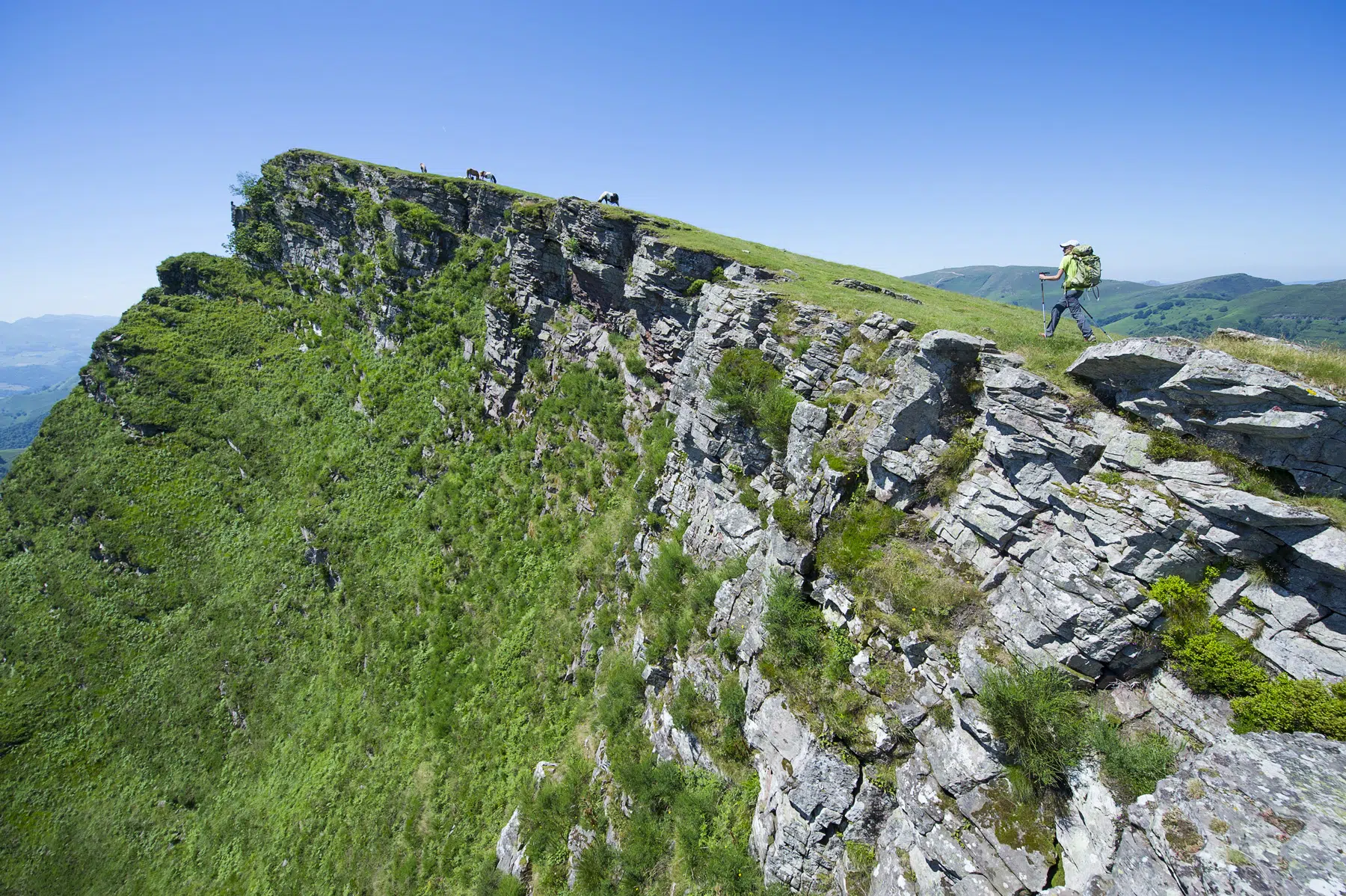
Sweeping views from the ridges of the GR10

Iconic Basque villages: Ainhoa, Espelette, Saint-Jean-Pied-de-Port

Local produce and Basque flavours at every stage

Total freedom, no logistics, no stress

A genuinely car-free adventure

Day 1

First Steps Around Itxassou

We arrive in Itxassou, settle into the welcoming rooms of the Txistulari – family atmosphere, lush garden, pool, restaurant – and if the legs are already itching, there’s time for a first short hike this afternoon.

at a glance  

The Legend of the Pas de Roland

We set off from the hotel on a 9 km loop (around 3h30, +400 m elevation) leading to the famous Pas de Roland, a natural arch carved into the rock above the Nive river. Legend has it that Roland, Charlemagne’s nephew, drove his horse’s hoof into the stone to cut a path through and fight the Saracens in 778 – the year he died at Roncesvalles. Fact or fiction, the site is striking: the river rushes below, the forest closes in, and the only sound is the hush of water over stone. A perfect warm-up for what lies ahead.

🚶 On foot from the hotel, no transport needed.

©Itxassou, Hôtel Txistulari, Extérieur / Txistulari

Your accomodation

Hôtel*** Txistulari

Set in a lush, peaceful garden in Itxassou, this family-run hotel-restaurant brings together comfort, a pool, generous Basque cuisine and a warm welcome. Spacious rooms, friendly staff, and an ideal base for exploring the Basque Country on foot, by train or by bus.

Day 2

Espelette and the Basque Valleys

Time to lace up the boots and head for the hills. Two options today, depending on how the legs feel.

at a glance

Peppers, Panoramas and Shepherd’s Paths

First choice: a 17.5 km hike (around 5h30, +500 m) leaving straight from the hotel along gentle paths through meadows and hamlets to reach Espelette, the village world-famous for its fiery red peppers that hang from every facade. We wander, we taste, then climb toward Mont Urzumu. From up here, the view opens across the Mondarrain and Artzamendi, and the Basque valleys spread out in a patchwork of deep greens. A gentle descent brings us back to Itxassou.

For a more relaxed version (12.5 km, around 4h, +400 m), the route is just as rewarding — at a gentler pace.

Second choice: head straight for the Mondarrain summit (749 m), a rocky peak with exceptional views over the entire Basque coast. At the top stands the Ikurrina, the Basque flag, alongside the ruins of a medieval castle belonging to the King of Navarre, occupied until the 15th century. The trail continues in a loop across open ridges before returning to Itxassou.

🚶 On foot from the hotel, no transport needed.

©Canoë / Evasion

tip

Splash

For a change of pace, the white water flowing down from the mountains offers another great playground. You can go canoeing, rafting or hydrospeeding from Itaxassou.

Day 3

On the GR10 Ridges, Between Cliffs and Vultures

One of the most intense days of the stay. We board the train at Itxassou, direction Bidarray — and the mountains take over.

at a glance

Altitude, Cliffs and Vast Silence

From Bidarray, several routes unfold depending on energy and ambition.

For those drawn to wild landscapes, the route via the Peñas d’Itsusi (18.5 km, around 6h45, +850 m) is unmissable. The name means ‘the ugly rocks’ in Basque, though they’re anything but. These sheer cliffs plunge dramatically into the valleys of Bastan and Aritzacun. We walk between rushing streams, vertiginous walls and breathtaking scenery, as griffon vultures glide overhead on vast wings. The pyramidal peak of Irubelakaskoa rises in the background. A landscape that feels like the edge of the world — yet surprisingly easy to reach.

Another option: make for the Col de Lacho and the Iparla ridges (15 km, around 6h, +1000 m). From shepherd’s paths, we climb to the Iparla summit (1049 m), the first peak over 1000 m in the Pyrenees when coming from the Atlantic, straddling the border between France and Spain. The 360° view sweeps from ocean to mountains. A suspended moment. A shorter version is also available (9 km / 3h30, +550 m) for a more relaxed pace.

🚂 Train from Itxassou to Bidarray. Return by train from Bidarray.

©Petit Train de la Rhune et Pottok / JM Decompte / ADT64

DID YOU KNOW?

LAND OF THE POTTOKS

The mountains are home to the famous Basque pottoks, small semi-wild horses that have lived on these slopes for centuries. You can spot them from a distance, or they might appear out of the blue, moving quietly across the landscape, just as they always have.

Day 4

Saint-Jean-Pied-de-Port, Irouléguy Vineyards and the Iparla Ridges

Back on the train, this time to Saint-Jean-Pied-de-Port. A day full of colour — and altitude!

at a glance

Medieval Lanes, Vines and Pilgrims of Santiago

From Saint-Jean-Pied-de-Port, several routes venture into the Basque hinterland. The hike to the Arradoy summit (15 km, around 5h, +600 m) crosses the Irouléguy vineyards before reaching this remarkable belvedere overlooking the valley. The descent winds gently back through cultivated hillsides and into the medieval streets of Saint-Jean-Pied-de-Port.

Passing beneath the Porte Saint-Jacques, we find ourselves walking alongside pilgrims heading to Santiago de Compostela. A chance to exchange a few words, hear their stories, discover where they’ve come from and where they’re going. An encounter that adds another dimension to the day.

For keen walkers, the route via the Munhoa (1023 m) along the GR10 (19 km / 7h, +950 m) rewards with panoramas stretching to the high Pyrenean peaks, before descending to Saint-Étienne-de-Baïgorry, tucked between vineyards and mountains. Return by bus then train to Itxassou.

🚂 Train from Itxassou to Saint-Jean-Pied-de-Port. Return by train, or bus + train from Saint-Étienne-de-Baïgorry depending on the route chosen.

©Linge basque collections Lartigue/ Lartigue

tip

Basque-Béarnese crafts

In Saint-Jean-Pied-de-Port, espadrilles are still made. Elsewhere, you can visit a factory producing berets, cowbells, linen, and chisteras (as Basque pelota remains the region’s signature sport), as well as a factory making makhila, the walking stick often given as a token of honour.

Day 5

Geology and Memory: the Larla Massif

For the final day, we choose a path less taken: quiet, intriguing, and deeply rewarding.

at a glance

A Landscape Shaped by Mining History

From Saint-Martin-d’Arrossa, a 12 km hike (around 4h30, +700 m) leads to the Larla summit (705 m) and its ancient open-cast mining sites. This massif was worked for over 2000 years, until 1914. The ochre tones of Basque sandstone still speak of that geological and human history. Today, the Larla is a pastoral landscape of rare biodiversity. From the top, the view plunges down across the north face of Iparla, that long vertical wall rising above the valley.

Less dramatic than the ridges of previous days? Perhaps. But this preserved trail offers something rare: near-total silence, untouched landscapes, and the quiet satisfaction of walking a path that few others take.

🚂 Train from Itxassou to Saint-Martin-d’Arrossa. Return by train from Saint-Martin-d’Arrossa.

©Fabrication de fromage en Vallée d’Aspe / Adrien Basse-Cathalinat / ADT64

tip

Yum. Local produce

The village of Itxassou, where you’re staying, is famous for its black cherries – the jam is delicious with a slice of sheep’s cheese, or in a Basque cake! In Espelette, it’s the chilli pepper that adds a kick to traditional dishes. Bayonne ham (cured with salt from Salies-de-Béarn) vies for your attention with chocolate. Cider and local beers, alongside Irouléguy wine and liqueurs… Discover these products at markets, direct from producers or in restaurants.

Good to know

Our tips for enjoying your stay

  • Choose the right season. Spring (May–June) or early autumn (September–October) offer the best conditions: mild weather, quieter trails, beautiful light.
  • Pack light: a day pack, at least 1 L of water, and comfortable walking boots. Some stages involve significant elevation gain.
  • Think reusable: bring your own cutlery and containers for picnics, and a bag to carry waste out.
  • Stay flexible: local public transport means the itinerary can always be adjusted depending on energy levels or the weather.
  • You can organise this holiday entirely on your own or choose to travel with Respyrénées.

Before you go

Frequently asked questions

Here are some practical answers to the most common questions, to help you plan your stay with ease and confidence.

Absolutely. It’s one of the most rewarding hiking destinations in France. The landscapes range from Atlantic coastline to Pyrenean ridges, with well-marked trails throughout. Some stages involve real elevation gain, but shorter alternatives are always available.

Not at all. The trip is designed for regular walkers (level 2–3 out of 5), with a shorter and a more challenging version for each day. We choose our route based on the day’s energy and mood.

Yes, that’s the whole point. Every hike is accessible by train or bus from Itxassou station. The travel documents provided include timetables and fares for each stage. A genuinely low-carbon adventure, from start to finish.

Spring (May–June) and early autumn (September–October) offer the best conditions: mild temperatures, quieter trails and stunning light. The trip runs from April to late October.

In hotels, restaurants and tourist shops, English is generally understood. In smaller, more remote villages, a few words of French or Spanish go a long way. And a smile works everywhere.

The trip is completely self-guided, so there’s total freedom to adapt. If the rain arrives or the legs need a break, we can opt for a shorter hike, explore a nearby village, or simply enjoy the pool and the hotel garden. The Respyrénées team and local tourist offices are always available for advice.

Rates

indicative budget

(Based on 1 people)


The price includes
  • Half-board accommodation from dinner on Day 1 to breakfast on Day 5 (3-star hotel with pool)
  • Travel documents with maps and topo guide (1 file per 4 people)
  • GPS tracks on request + access to the detailed itinerary on the GPS Mhikes mobile app
The price does not include
  • International transport to/from Itxassou
  • Travel insurance
  • Meals not mentioned above
  • Transport costs (train, bus, boat shuttle…)
  • Entrance fees and visits
  • Drinks and picnics
  • Administration fee (€15 per file)

This might interest you

Experience the NOuvelle-Aquitaine

For the undecided, the charm of the South-West France can be found throughout the region. Go explore our other destinations, from the foothills of the Pyrenees to the hidden villages of Deux-Sèvres, or enjoy surf sessions on the coast and hikes in the vast landscapes of Limousin. You will certainly find the stay that suits you.