Bordeaux: 7 ways to experience the city, the vineyards and the ocean
There's the honey-coloured stone glowing in the sun, the quays you set off from to explore the city, the café terraces spilling over almost all year round. Bordeaux, the world capital of wine and a UNESCO World Heritage city, never sits still. And all around, barely an hour away, the vineyards, the estuary, the great lakes and the ocean are a reminder that here, escape begins at the end of a tram line.
Table of contents
You’ll love
exploring the Port de la Lune, Europe’s largest UNESCO-listed urban area
Hopping on the tram to visit the great wine estates
And the train to reach the gems of Arcachon Bay
Crossing from one bank of the estuary to the other by ferry, under Vauban’s watch
The Port de la Lune and the UNESCO heritage of Bordeaux
Picture the scene: 18th-century façades stretching for miles, pale golden stone that turns to honey the moment the sun touches it, and the Garonne tracing a long crescent curve. The Port de la Lune (the Port of the Moon) is UNESCO-listed, Europe’s largest inscribed urban area, almost half the city. You explore Bordeaux along the quays before veering off into one district or another, from colourful Saint-Michel to the antique dealers of the Chartrons. And you always end up taking off your shoes to paddle in the Miroir d’eau, the great reflecting pool, just like the children beside you.
Nothing frozen about it, though. In a wartime submarine base, the Bassins des Lumières drown the old masters of painting in projections that stream down the concrete and the dark water. A 19th-century warehouse has become the CAPC contemporary art museum. And outside, on the walls, street art answers the ancient stone. Bordeaux never stops rewriting itself.
Worth a try: climbing the Pey-Berland tower to see the city curled around its crescent of river.
Darwin, the Capucins and the Bordeaux art of living
Here, you don’t rush, you sit down to eat. In the morning, you linger at the Capucins market, the belly of Bordeaux, among the oyster stalls and the cafés where you decide what comes next. At midday, you pick one of the city’s food halls and travel through its flavours. In the afternoon, you stretch out under one of the remarkable trees of the Jardin Public — the natural history museum is right next door. And as the light fades, you head up to a rooftop, from the Mama Shelter to the Gina bar, to watch the façades turn pink.
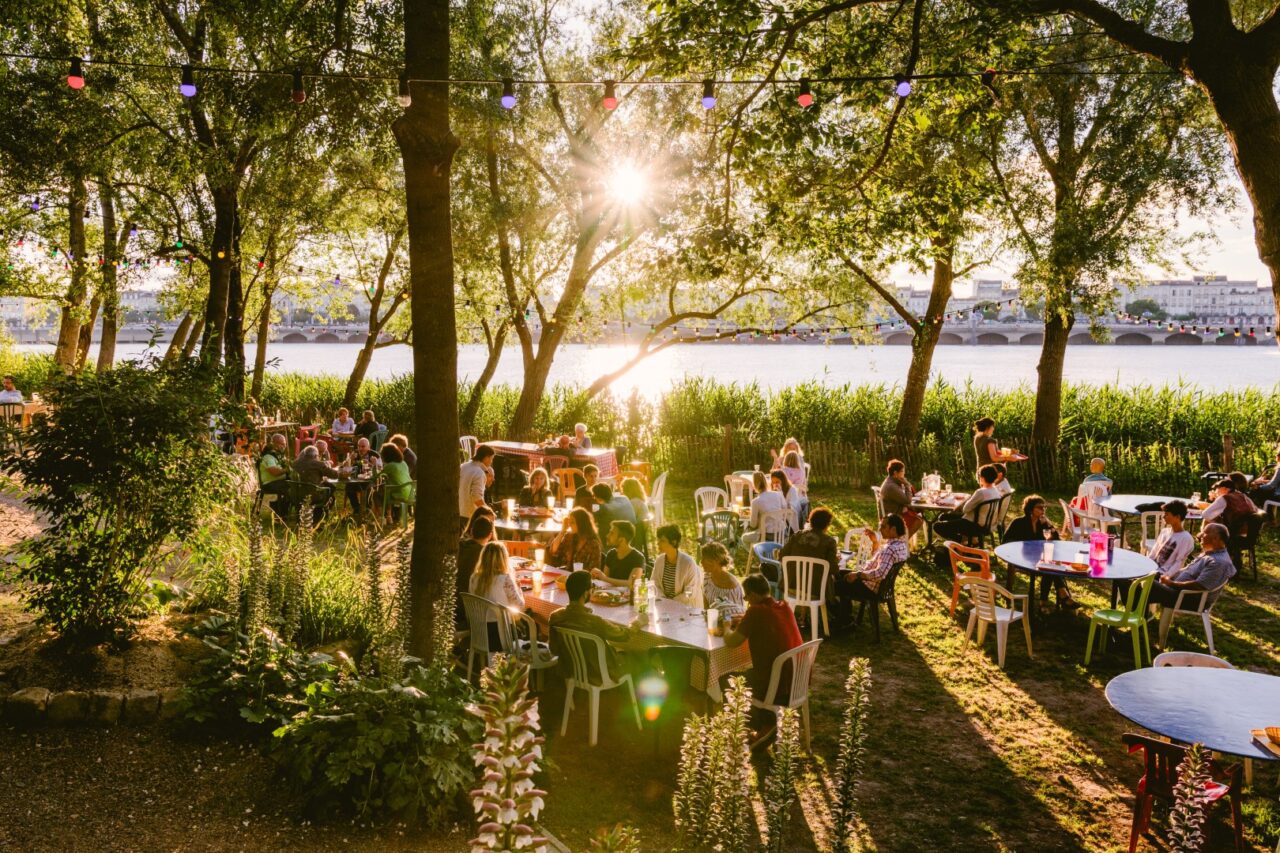
But you could just as easily spend almost a whole day at Darwin! On the right bank, in a former barracks, it’s a world of its own: a hall covered in murals, skate ramps, an organic canteen, designers’ studios. You brunch there and, come evening, you linger at a nearby guinguette, an open-air riverside bar, with an unbeatable view of the lit-up façades across the water. Listed, yes. Stuffy, never.
Welcome to the world capital of wine. It has its own way of greeting you: not a glass simply handed over, but an invitation to understand. La Cité du Vin, a building of glass and aluminium rippling like wine swirled in a glass, shows wine in a new light: across the world, across the ages, through every culture and civilisation. Senses awakened, you go up to the belvedere to take in the whole city, glass in hand. Down in town, you push open the door of a wine bar where the owner champions his biodynamic wines the way you’d champion a cause.
Did you know that Bordeaux has vines right inside its metropolitan area? No need for a car to see a château rise at the end of a row of vines and taste, in an architect-designed cellar, the estate’s own nectar. This is where wine stops being a label and becomes a landscape you savour with every sense.
Worth a try: a beginners’ workshop at the Bordeaux Wine School, opposite the tourist office, to finally put words to what you’re tasting.
Thirty minutes by train from Bordeaux, the Bordeaux–Sarlat line (line 33), and you’re there. Saint-Émilion appears, a medieval village clinging to its hillside, cobbled lanes tumbling down towards a church carved straight out of the rock, and the smell of macarons fresh from the oven. No car to park: you climb on foot towards the centre, and already the châteaux line the way. Ten minutes from the station, La Gaffelière, one of the great names of the appellation, opens its vat room and underground cellar; a little further on, Villemaurine rewards the effort with a tour of its underground caves.
The same train carries on to Libourne, gateway to the right bank: Pomerol and its great wines, Fronsac and its slopes, all within easy reach. You hop on a bike, follow the rows, push open the gate of an estate — Château de Ferrand, say, in the same family since 1934, three kilometres from the station. And you find that even the greatest names have kept something of their country simplicity.
The Médoc is, first of all, a string of names that make wine lovers the world over dream. Here too, the train is enough: line 42 heads for the Pointe de Grave through the vines, and you step off at Margaux, Moulis-Listrac or Pauillac, at the foot of the châteaux. Fifteen minutes from Margaux station, Marquis d’Alesme unfolds its park and its pleasure pavilion, while Château Ferrière, now organic, welcomes the children with grape juice in hand while their parents taste. Higher up, Maucaillou tells the story of the craft in its little museum, and Chasse-Spleen has a name that sounds like an invitation to the good life.
But to reduce the Médoc to its wines would be to miss its other treasures. Several châteaux (Beychevelle, Grand-Puy Ducasse) look straight out over the Gironde estuary. Carrelets (square fishing nets on stilts), islands, a whole other world opens up. And on the far side of the peninsula, you find yourself cycling through balsam-scented pines before settling by one of the freshwater lakes (Hourtin-Carcans-Maubuisson, the largest in France, and Lacanau). Behind the dunes, the ocean sings and the fine sand goes on forever.
The citadel of Blaye, the village of Bourg and the Corniche
Get ready for an eyeful! You enter the citadel through the Porte Royale before exploring its every corner, from the ramparts with their sweeping views over the river to the underground passages that tell the soldiers’ story. Between a pause among the artisans’ shops and a drink on a terrace, you find yourself caught up in this tale of a defensive “lock” devised by Vauban in the 17th century. Together with Fort-Médoc on the left bank and Fort-Pâté set on its islet, it once guarded the port of Bordeaux, and is now part of the UNESCO World Heritage list.
The sunsets here are magical, as they are all along the Corniche road, which runs at the water’s edge, between carrelets on stilts and vine-covered slopes. It leads to Bourg, a medieval town perched on its rocky spur above the Dordogne, an upper town and a lower town, the harbour below and a wonderfully photogenic washhouse.
Worth a try: down below, the ferry quietly links Blaye to the Médoc, from one bank to the other, without going back through the city.
Arcachon Bay, from the Dune du Pilat to Cap-Ferret
An hour by train from Bordeaux, and the tempo changes. Here, the tide is in charge: it transforms the bay, uncovers the oyster beds, the Île aux Oiseaux (Birds Island) and its curious cabanes tchanquées (huts raised on stilts) then comes back to cover it all again. You sit down at a hut on an oyster-farming port, at Gujan-Mestras, Andernos or Le Canon, a dozen oysters and a glass of white, watching the wooden pinasses(the bay’s traditional boats) drift by. Time stretches out. You hop on a bike to take in the local gems along the way, thanks to a fine network of cycle paths: a seawater pool and nature reserve at Audenge, a Byzantine-style church at Le Moulleau, the villas of the Ville d’Hiver in Arcachon, the village of L’Herbe out on the peninsula… What if you stayed a few days?
Arcachon Bay opens onto the ocean between two giants facing each other. To the south, the Dune du Pilat, the highest in Europe, which you climb barefoot in the sand for a one-of-a-kind view: forest on one side, water on the other. To the north, the chic Cap-Ferret peninsula, its red-and-white lighthouse and its beaches turned towards the open sea.
Worth a try: visiting the Teich bird reserve, a 20-minute walk from the station. Here, migratory birds put on a colourful show, in a royal silence.
Set off to explore our destinations: from the foothills of the Pyrenees to hidden villages, from surfing sessions on the coast to hikes in the wide open spaces of the Limousin. You’re bound to find a holiday that takes your fancy.
To find out more about the destination or the experiences on offer there, here are a few pages that invite you to continue your exploration, either online or in person.